The Philippine Energy Efficiency Project (PEEP) was established by the Philippine Government and is being implemented by the Philippine Department of Energy (DOE) with support from Asian Development Bank and IIEC.
The project, with a total approved budget of 46.5 million US dollars, covers a series of activities with the aim of reducing electricity consumption in the residential and public sectors, reducing the peak load power demand, reducing health risk associated with residual mercury and kerosene (in off-grid areas) and establishing a certification process for energy efficient and green commercial buildings. As of August 2012, the PEEP project team has successfully completed the implementation of the following activities:
- Nationwide distribution of 5 million Compact Fluorescent Lamps (CFLs) which translate to an estimated energy savings of 44.7 kWh per incandescent bulb (IB) replaced1 and annual energy savings of 223.56 GWh.
- Retrofitting of 35 government buildings in Metro Manila: Installation of T5 14W lighting systems in 2,718 luminaires with 5,994 lamps and T5 28W lighting systems in 39,148 luminaires with 57,533 lamps. Measurement and verifications conducted indicate power demand reduction of 635 kW resulting in an annual energy saving of 1.37 GWh.
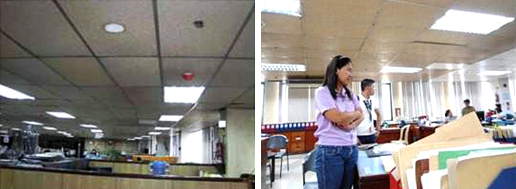
 Retrofitting of 35 government buildings in Metro Manila
- Retrofitting of park lights in Baguio City: Replacement of 150W mercury vapor lamps with 70W high pressure sodium vapor lamps and the replacement of 358W decorative lamps with 15W bollard type compact fluorescent lamps. This resulted in a total power load reduction of 61.94 kW and total annual energy saving of 269.28 MWh.
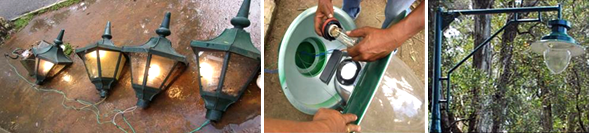
Retrofitting of park lights in Baguio City
- Retrofitting of streetlights and traffic lights in Cagayan de Oro City: Retrofit of 2008 mercury vapour lamps ranging from 70 Watts – 500 Watts, with 70 Watts – 150 Watts High Pressure Sodium Lamps in the streetlights of 27 barangays. The project team also replaced traffic and pedestrian lanes lights with Light-Emitting Diodes (LED) lamps in four major intersections in the City. The replacement included the installation of fixtures and necessary accessories and controls. Total power load reduction was of 182.86 kW which translates to annual energy saving of 779.28 MWh.
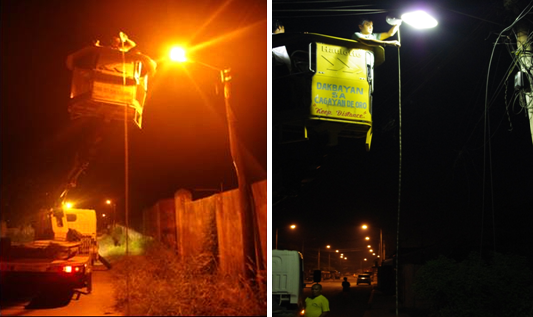
Retrofitting of streetlights and traffic lights in Cagayan de Oro City
- Retrofitting of 159 traffic intersections with LED in Metro Manila. This resulted in a power load reduction of 566 kW and annual energy savings of 4.96 GWh.
As of August 2012, the PEEP has already reduced power load by 242 MW and total annual power consumption by 315 GWh. This is estimated to have reduced an annual equivalent carbon emission of 170,167 teCO2. During the forthcoming months, the PEEP project team will be distributing an additional 3.6 million CFLs which is expected to generate an additional annual energy savings of 82.78 GWh2. Furthermore, PEEP is now expanding the energy efficiency lighting retrofits to an additional 100 government buildings nationwide which including government owned hospitals, schools and office buildings. With regards to street lighting, additional LED lights will also be retrofitted in 1,484 luminaires within 2-4 kms from the Ninoy Aquino International Airport.
Based on the values presented above, the project will be exceeding its original goal of power reduction of 238 MW and annual energy savings of 313 GWh upon project completion.
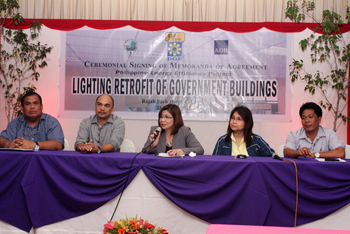
Signing of Memorandum of Agreement (MOA) with the Beneficiaries of the
Retrofitting of 100 Government Buildings
For further information, please contact Angelica Dealino -
1 Assumption: the 15W CFL distributed replaced a 50W Incandescent Bulbs (IBs) and IBs operate on average about 3.5 hours per day, 365 days per year.
2 14W CFLs will be distributed in the succeeding lot.