

EXECUTIVE SUMMARY 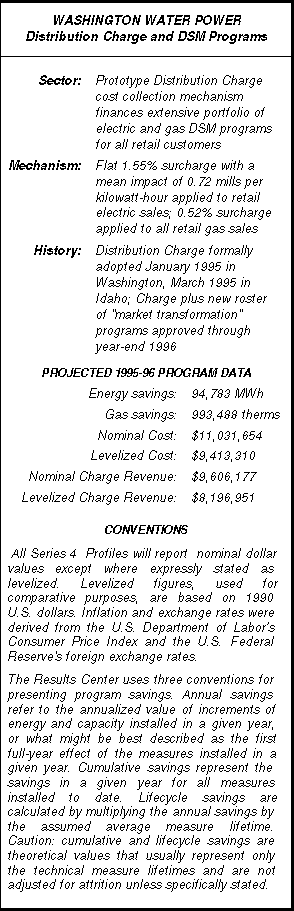 Washington Water Power’s Distribution Charge, formally known by its regulators as "the DSM Tariff Rider," is the most sophisticated model of its kind and a powerful harbinger of what may well become the future predominant energy efficiency services funding mechanism in a competitive utility environment. As similar structures have been proposed by states across the nation, Washington Water Power (WWP) has not only implemented the first "non-bypassable systems benefits charge" but is also the first utility to provide results on the success of the model’s implementation.
Concurrent to the introduction of the Distribution Charge was a complete overhaul of WWP’s approach to energy services. WWP has refined its focus on maintaining efficiency through market transformations, developing a constructive response to regional and national pressures. Its staff and advisors created new efficiency program designs to maximize effects while minimizing costs through an emphasis on becoming technical consultants and customer-focused energy service providers.
An enabling aspect of the Distribution Charge’s evolution has been the corporate culture within WWP. Despite projected excess capacity well past the year 2000, WWP’s management is committed to efficiency as a customer service and in this regard has responded to competition proactively. It developed the prototype Distribution Charge long before many others were aware of the concept. It was the first utility in the Northwest to propose that its largest customers gain direct access to their choice of suppliers. The Distribution Charge provides a pay-as-you go mechanism for continuing efficiency in a direct access environment and in the future will make WWP’s power prices easily comparable with competitors’ rates.
The DSM Issues Group, known as "DIG," was formed at the request of WWP's regulatory commission and was comprised of WWP staff along with representatives from seven key regional agencies. The utility’s openness in DIG’s extensive meetings over a 30-month period have been credited with shaping WWP's progressive energy services posture. Now its initiative to open up its territory to retail wheeling fills out the model as the cost of all kilowatt-hours sold within its service territory will include the Distribution Charge.
The Distribution Charge has increased electric rates by approximately 1.55% and gas rates by 0.52%. Thus typical monthly residential electricity bills have increased by 81¢ and gas bills by 16¢,... well within the bounds confirmed acceptable by a telling customer survey conducted by an independent market research firm. Thus WWP's pioneering efficiency model provides a win-win result for utility and customers alike.
[CLICK HERE TO DOWNLOAD THE ENTIRE 27 PAGE PROFILE IN PDF FILE FORMAT]
This profile was produced by