



EXECUTIVE SUMMARY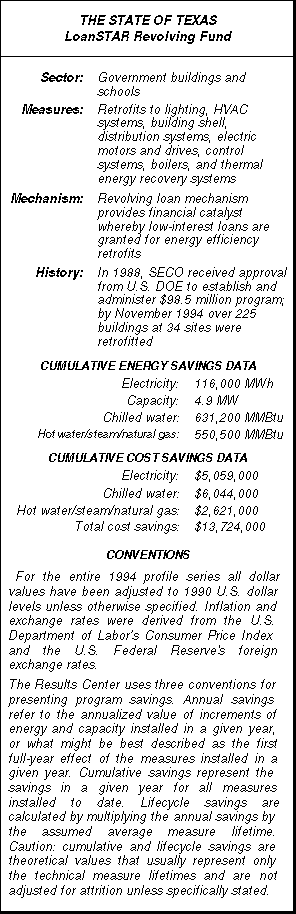 The State of Texas’ LoanSTAR program is a model design for retrofitting public buildings. By loaning money to existing institutional facilities at low-interest rates the Loan to Save Taxes and Resources program is a revolving loan fund that has enabled a tremendous amount of retrofit activity in medical institutions, schools, libraries, university buildings, state offices, and other public facilities that would otherwise simply not have occurred.
LoanSTAR has leveraged significant dollar savings through the use of oil overcharge funds, money that the Federal government sought to have redistributed for maximum societal benefit. By identifying exceptional retrofit candidates, auditing facilities, enabling retrofits, and then working closely with facility managers to maximize operational improvements over time, through the use of approximately $100 million dollars worth of loan fund activity LoanSTAR has the potential to leverage as much as $850 million in savings over the next 20 years.
One of most important aspects of LoanSTAR has been its emphasis on monitoring and verification of energy savings. Rather than resting on auditors’ projections and engineering estimates of potential savings, the State of Texas instead chose to carefully analyze the program’s impact. To fulfill this function, the State Energy Conservation Office contracted with the Energy Systems Laboratory (ESL) at Texas A&M University. Through this collaboration and ESL’s extensive knowledge of building systems, LoanSTAR has a tremendous amount of technical depth as well as resilience to political shifts that might have otherwise threatened a less well-documented program. Through careful attention to the detail uncovered through rigorous monitoring procedures, the program has achieved even greater savings through operations and maintenance improvements.
By the end of 1994 and only four years, LoanSTAR had provided capital for the retrofit of over 22 million square feet of space in 225 buildings at 34 sites. The average payback of the projects was 3.5 years while the program has stimulated retrofits ranging from lighting conversions to HVAC upgrades, shell improvements, high efficiency motors and variable speed drives, energy management control systems, and boiler upgrades. Already the program has generated over $20 million in cost savings derived from reductions in the use of electricity, natural gas, steam, and chilled water.
Given the challenges to conventional energy efficiency incentive programs promoted by utilities, revolving loan funds will likely become that much more important as a means of providing capital for cost effective retrofits in institutional facilities. While oil overcharge funds are drying up, the model that LoanSTAR represents can be funded through utility seed capital programs and from Federal, state, and municipal sources. LoanSTAR represents an attractive program design for the capture of efficiency in institutional facilities that can and likely will be replicated in other states and jurisdictions keen on the success enjoyed by the program in Texas.
[CLICK HERE TO DOWNLOAD THE ENTIRE 23 PAGE PROFILE IN PDF FILE FORMAT]
This profile was produced by