EXECUTIVE SUMMARY
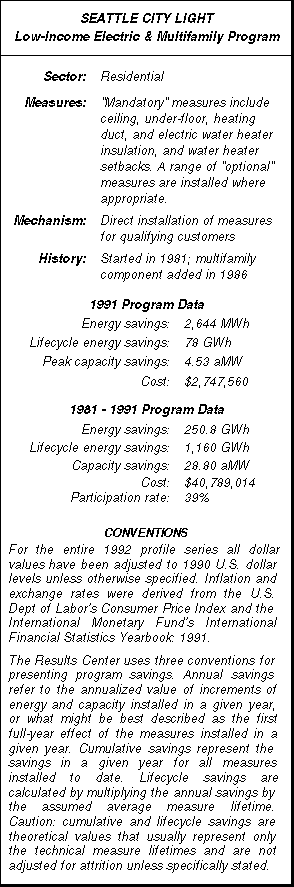 "In some ways, Seattle is an Ecotopia," noted a Seattle City Light official, an Ecotopia where a long term commitment to low income weatherization is possible and a successful track record has indeed been proven. In addition to Seattle's progressive orientation, Seattle City Light has benefitted from Bonneville Power Administration's Energy Buy Back Program, whereby the utility's cost for conservation programs is partially offset by BPA's acquisition of conservation resources throughout the Northwest region.
The Seattle City Light (SCL) low income weatherization programs described in this profile are jointly administered, with the City's Department of Housing and Human Services (DHHS), and are targeted at two discrete sectors: single family and multifamily. For single family homes, the City provides the Low Income Electric Program (LIEP). For multifamily structures, the City offers the Multifamily Conservation Program (MFCP).
The City of Seattle, and Seattle City Light in particular, has had a long history with low income weatherization programs. In 1981 the City Council adopted an ordinance enabling the programs. Since then, some 15,109 low income units have been weatherized: 9,673 single family units, 836 multiplex units (2-4 apartments), and 4,600 multifamily units. Weatherization of these homes has resulted in average annual energy savings per home of 3,100 kWh, 1,308 kWh, and 1,640 kWh respectively. In terms of total cumulative savings, the low income programs to date have saved 250 GWh, and will create lifecycle savings of 1,160 GWh.
The programs' expenditures support the City's commitment to weatherization. Qualified LIEP participants are granted up to $3,300 per single family home, $4,000 per duplex, $5,000 per triplex, and $7,000 for a fourplex. For the MFCP, there is no per unit ceiling on expenditures. Total annual costs of the programs have ranged from just over a million dollars in 1981 to a high of over $6 million in 1983, to $2.7 million in 1991. Of the $41 million spent to date, fully $27 million has gone into expenses directly related to the installation of the efficiency measures.
Using two city agencies to deliver a program has its advantages and disadvantages. On the up side is a diversity of talents. SCL has a long track record with demand-side management and with effectively delivering and evaluating programs. DHHS, on the other hand, is an agency devoted to social services and thus ideally suited to reach out to and serve Seattle's low income population. Among its abilities are translation services including Chinese, Laotian, Russian, Vietnamese, Cambodian, and Ethiopian for program participants.
[CLICK HERE TO DOWNLOAD THE ENTIRE 20 PAGE PROFILE IN PDF FILE FORMAT]
This profile was produced by