



EXECUTIVE SUMMARY
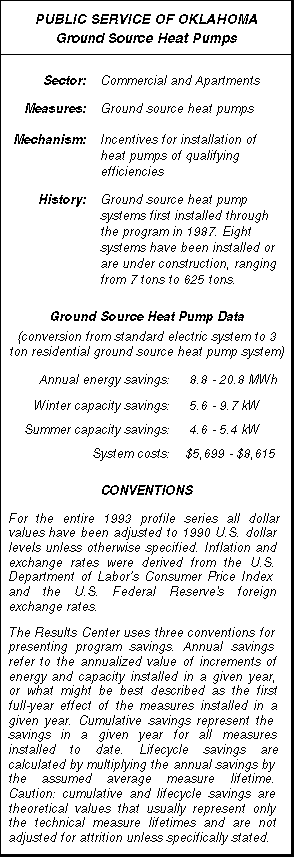 Jim Ezell of Public Service of Oklahoma notes that, "Ground source heat pumps are really a product of Oklahoma. While the technology can be applied across the United States and perhaps around the world, it has its genesis in Oklahoma." Thus it is fitting that this profile focuses on the PSO program and incorporates the national perspective by using detailed analytical work done by U.S. Environmental Protection Agency.
Ground source heat pumps, like water and air coupled heat pumps, have distinct advantages over conventional HVAC systems but have been criticized by some environmentalists as electrification technologies whose primary purpose is to increase energy sales. Nevertheless, utilities and energy policymakers simply cannot ignore the fundamental efficiencies of these systems and must carefully analyze their potential applications compared to standard HVAC systems, taking into account geographic location, fuel availability, and regional power sources.
While ground source heat pumps have been installed in a variety of applications for more than 30 years, recent advances in the technology have opened up the market for increased installations. Ground source heat pumps work on the same principle as air source heat pumps. Instead of exchanging heat with the air, a loop of water and antifreeze is circulated through the ground. Through the loop, heat is extracted from the ground during the winter, and deposited into the ground in the summer.
Public Service of Oklahoma (PSO) promotes installation of ground source heat pumps through its Good Cents Commercial and Good Cents Apartments programs. These programs offer financial incentives for installing energy-efficient heat pumps. Incentives are the same regardless of whether the heat pump is ground source, air source, or water source. Additionally, customers may receive a lower winter heating season electric rate if they meet several program criteria, including installation of an energy-efficient electric heat pump. Customers who meet all Good Cents criteria also receive higher incentives than those who install heat pumps unaccompanied by other energy-efficiency measures.
Although there are many benefits to ground source heat pump systems, there are also some obstacles that may make their installation less desirable or impractical to a building owner. First, he or she must be willing to take a long-term view regarding system benefits. The systems have high first costs, which, even when offset by PSO’s incentive, are typically not paid back through low operating costs and energy savings for five to seven years. Second, the building site must be of appropriate size and geology. Horizontal loop systems require a sizeable footprint and both horizontal and vertical systems require geological characteristics that are amenable to trenching or drilling.
[CLICK HERE TO DOWNLOAD THE ENTIRE 18 PAGE PROFILE IN PDF FILE FORMAT]
This profile was produced by