

EXECUTIVE SUMMARY
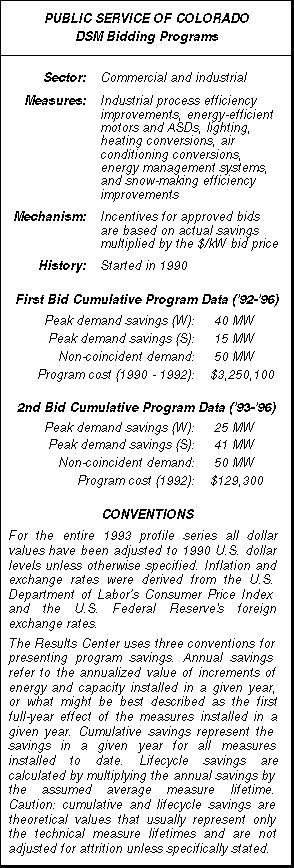 Bidding programs represent what many DSM analysts consider the next evolution of utility-driven energy efficiency programs. Rather than relying on conventional or core DSM programs which typically induce a subset of customers to implement varying degrees and combinations of energy efficiency measures, bidding programs leave it up to the customers to determine what energy-efficient measures and process changes they might implement if paid a certain price to do so. Bidding has been the emphasis of Public Service Company of Colorado’s DSM activities to date, but the utility has also introduced several other programs for its customers since it began DSM in earnest in February of 1989.
Demand-side bidding is a process whereby a utility issues a request for proposal (RFP) for energy and/or capacity savings, the latter in the case of Public Service Company. The RFP is sent to customers, energy service companies, and other third parties. The premise behind DSM bidding is that the competitive nature of bidding will provide market driven costs for implementing DSM measures. As such, bidding programs allow customers a wide degree of latitude in determining how best to accomplish cost effective energy efficiency savings for themselves and for the benefit of their utilities.
For the purposes of this profile we consider Public Service of Colorado’s three DSM Bidding programs to date: a small 2 MW pilot program, the First 50 MW Bidding program, and the Second 50 MW Bidding program. In mid-1989 PSC began the pilot program and sent out an RFP for 2 MW. This solicitation resulted in the submission of nine proposals totaling 6 MW with an average cost of approximately $240/kW. Following the success of this pilot program PSC received authorization to solicit bids for 100 MW of demand savings in two 50 MW bid increments.
Perhaps the two most important aspects of the bidding programs have been for PSC to determine the cost of customer-driven conservation and to refine its bidding processes over time. To these ends, the bidding programs have been remarkably successful. In addition to finding out that a tremendous, cost effective DSM resource exists which can be delivered to the utility at about half its avoided cost, the bidding programs have provided a host of important lessons learned that other utilities will certainly want to consider as they "roll out" similar programs.
[CLICK HERE TO DOWNLOAD THE ENTIRE 20 PAGE PROFILE IN PDF FILE FORMAT]
This profile was produced by