

EXECUTIVE SUMMARY
 Pacific/Utah Power, the electric generation and distribution divisions of PacifiCorp, is a forerunner in a new and innovative type of efficiency program in which customers repay the costs of their efficiency installations through monthly energy service charges on their electric bills. While the jury is still out on the effectiveness of this approach compared to more traditional rebate and other incentive programs, Pacific/Utah Power’s pioneering efforts with financing energy services for its customers is a model that is being closely watched around the country.
Pacific/Utah Power classifies its DSM programs into one of two categories: Energy Service Charge (ESC) and non-ESC programs. The ESC programs provide customers with up-front capital to finance the incremental cost of efficiency measures which exceed current building code requirements or common practices. In return the participant pays a monthly energy service charge directly to the utility. The time period of the energy service charge varies and the interest rates are competitive with the market.
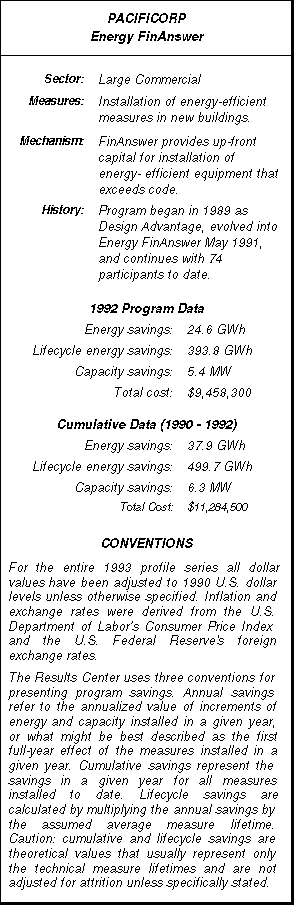
The Energy FinAnswer program is an "investment-based energy service charge program" which is currently offered by Pacific/Utah Power in seven states: Oregon, Utah, Idaho, California, Washington, Wyoming, and Montana. The Energy FinAnswer for large commercial customers, the focus of this profile, offers a wide range of services including modeling, financing, and performance verification. Since 1990, 74 buildings have signed energy service contracts with The Energy FinAnswer program, accounting for more than 4.5 million square feet of new and renovated commercial construction. The efficiency measures add value to the building through lower operating costs, as well as increasing comfort and aesthetics. The costs for the measures are actually repaid over time with money saved in operational expense.
The 74 buildings that participated in The Energy FinAnswer program from 1990 through December 31, 1992 are estimated to have total annual energy savings of 31,232 MWh. Cumulative energy savings are 37,879 MWh; lifecycle savings are projected to exceed 499,000 MWh. Average annual capacity savings for the program have progressed from 0.002 MW in 1990 to 0.942 MW in 1991, to 5.364 MW in 1992.
While many energy analysts continue to debate the virtues and potential pitfalls of the energy service charge concept in general and The Energy FinAnswer program in particular, the program, or what some consider an "experiment," is beginning to receive more and more attention. If the utility proves that it can maintain high levels of participation at low costs -- essentially serving its customers with a low-cost financing coupled with key energy efficiency services -- then the program mechanism will likely be widely sought and implemented across the country for the large commercial sector.
[CLICK HERE TO DOWNLOAD THE ENTIRE 23 PAGE PROFILE IN PDF FILE FORMAT]
This profile was produced by