EXECUTIVE SUMMARY
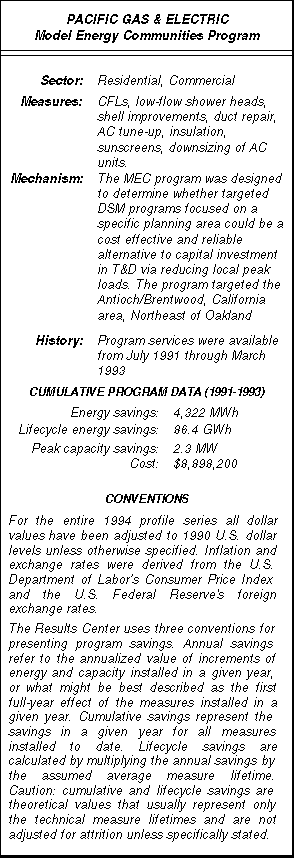 Pacific Gas & Electric’s Model Energy Communities (MEC) Pilot program, what has been commonly called "The Delta Project," was a research initiative that not only serves as a model for a new and innovative form of demand-side management, but which also has provided a host of important lessons learned. The project was conceived to test the opportunity to use DSM as a localized least cost resource, thereby deferring the need for the capital expansion of transmission and distribution systems.
The region served by The Delta Project is largely residential (a classic "bedroom community") with some 25,000 homes, the vast majority of which are owned by two-income families that work in San Francisco or Oakland and return home at the end of the day. At that time, and especially when temperatures exceed 105° F, the homeowners concurrently turn on their air conditioners creating a localized spike in demand. While The Delta Project sought to contain this needle peak through energy efficiency measures, a key lesson learned was that load management options, such as appliance cycling in particular, may have provided a more expeditious means of fulfilling the Project’s load shape objective.
The Delta Project was not only ambitious in scope and purpose, but also needed to be implemented quickly to fulfill its basic purpose of substation deferral. The Project was implemented in approximately 18 months in a geographically succinct area focused on the proposed Lone Tree substation. It was designed to assess whether DSM could be a cost effective alternative to substation construction; to determine whether intense marketing and direct install program delivery could result in desired levels of savings by triggering high participation and penetration levels; and to assess customer acceptance of such a strategy.
Many rich lessons were learned by PG&E program staff: First and foremost, the project did serve to defer the construction of the Lone Tree substation, although disaggregating the program’s effects from other factors such as the depressed new residential construction market and weather patterns was complex. Second, the program succeeded in delivering a host of DSM measures in a short time frame. This, however, was not without difficulty. PG&E also learned an important lesson about the homogeneity of neighborhoods and thus their relative lack of end-use and end-use consumption diversity. Perhaps most importantly, The Delta Project highlights the litany of unanticipated factors that relate to such a program design, knowledge which can now be used to help program designers to develop effective T&D deferral programs in the future.
[CLICK HERE TO DOWNLOAD THE ENTIRE 23 PAGE PROFILE IN PDF FILE FORMAT]
This profile was produced by