EXECUTIVE SUMMARY 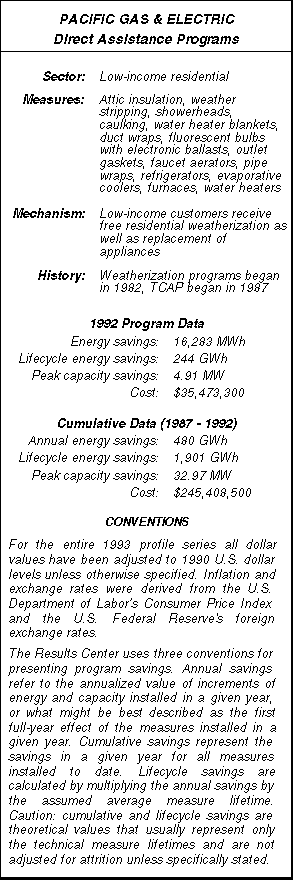 Over its ten-year history Pacific Gas and Electric’s Direct Assistance programs (Energy Partners and Target Customer Appliance Program) have weatherized more than 600,000 low income homes at a total program cost of nearly a quarter of a billion dollars. In addition, since 1987 more than 90,000 appliances, primarily refrigerators that exceed federal appliance efficiency standards but also furnaces, evaporative coolers, water heaters, etc. have been replaced with energy-efficient models at no charge to low income customers. In addition over 70,000 compact fluorescent lamps were installed as part of TCAP.
Despite the fact that the Direct Assistance programs are clearly not cost effective as defined by the total resource cost test nor the rate impact measure test, the programs have been mandated by the California Public Utilities Commission which has considered the programs very important. So important, in fact, that PG&E’s shareholders were rewarded with over a million dollars in incentives for their $35 million programs in 1992.
The Energy Partners component of the Direct Assistance programs has been through an evolution that has enhanced the program, refining its delivery mechanism and quality control procedures, but which unfortunately complicates this profile somewhat and obfuscates its data. Originally part of PG&E’s Zero Interest Program, it is now its own program area. The program’s initial mandate was to provide "Big Six measures" to low income customers including attic insulation, weatherstripping, caulking, water heater blankets, low-flow showerheads, and duct insulation. Then PG&E added "Non "Big Six" measures to the program including fluorescent bulbs, outlet gaskets, faucet aerators, home repairs, pipe wraps, furnace filters, and evaporative cooler covers. In addition, an energy specialist spends up to three-quarters of an hour in each home providing owners with advice on energy saving tips, developing a personal energy savings plan, and completing an Energy Partners Agreement with the customer.
Currently PG&E’s program staff are experimenting with two pilot programs that may become incorporated into the program design in the future. The Blower Door Pilot was developed to test the appropriateness of using blower door equipment to determine optimal weatherization measures. In 1992, 1,392 blower door tests were completed. A Pen-Based Computer Pilot was tested in 88 of these homes to evaluate the effectiveness of creating a paperless program, a refinement that many utilities across the country may implement in the not-too-distant future!
[CLICK HERE TO DOWNLOAD THE ENTIRE 24 PAGE PROFILE IN PDF FILE FORMAT]
This profile was produced by