








EXECUTIVE SUMMARY
 Norway is a country blessed with abundant energy resources, awash in hydroelectricity, or what Norwegians call "the clean energy," as well as North Sea oil and gas. Norway’s energy self-sufficiency is the envy of many other energy-strapped countries. What makes this profile so intriguing is that Oslo Energi and the City of Oslo have pioneered the use of an innovative revolving fund to promote energy efficiency that may well become an internationally-acclaimed model for the finance of energy efficiency, but which ironically has been generally underutilized in Oslo itself.
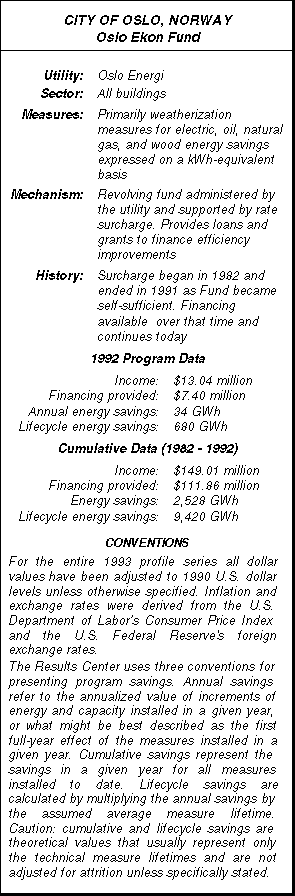
The Ekon Fund established by the City of Oslo in 1982 has proven to be an elegant mechanism for providing and facilitating a pool of capital for retrofits. The Fund was developed by applying a small surcharge on each kilowatt-hour sold in Olso. (The Fund has been supported with a 0.16 ¢/kWh surcharge, equal to 2.9% of average electricity rates.) This "fresh" capital, plus interest earned on the balance and oustanding loans, has created a fund of significant magnitude.
To date the Ekon Fund has enabled approximately 20,000 customers within Oslo to engage in efficiency retrofits that have resulted in 2,528 GWh of energy savings. These projects have cost a total of over $110 million. In its "banner years" the Fund saved 65 GWh, 59 GWh and 62 GWh annually. Ironically, the Fund has been challenged by its success as its primary shortcoming has been its own inability to grant and loan money fast enough. Its current balance of approximately $100 million U.S. dollars (577 million NOK) has become highly attractive to politicians keen on reallocating the money for other social programs. But for now, the City has decided to guard the Fund against such uses and maintain its capital for its original purpose: energy efficiency retrofits.
The Oslo Ekon Fund is the primary focus of this profile and represents a brilliant financing mechanism for energy efficiency that may be best transferred to other jurisdictions for a number of reasons. Energy efficiency is typically driven by high prices, which Oslo does not have. Efficiency is driven by shortages of power, which Oslo does not have. Finally, energy efficiency is driven by concerns about the security of future power supplies, and this is not a Norwegian concern either! Thus the mechanism and the full service orientation of the Fund make a good deal of sense and may be successfully replicated elsewhere, but the Fund has been proportionately less successful in Norway,... one of the Northern Hemisphere’s great energy anomalies!
[CLICK HERE TO DOWNLOAD THE ENTIRE 24 PAGE PROFILE IN PDF FILE FORMAT]
This profile was produced by