EXECUTIVE SUMMARY
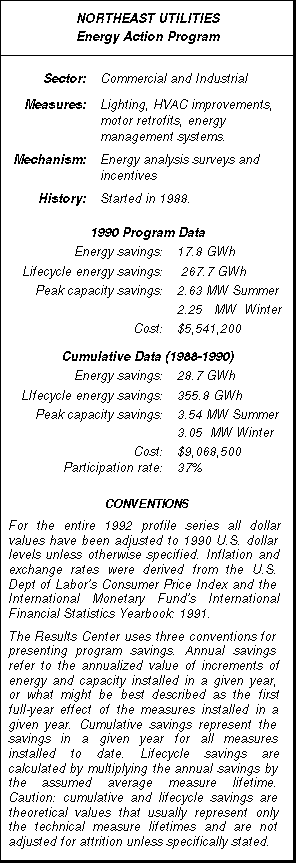 Northeast Utilities’ Energy Action Program (EAP) offers incentives to large commercial and industrial customers who retrofit existing facilities with energy-efficient equipment in the service territories of both Connecticut Light & Power and Western Massachusetts Electric Company. Non-residential customers whose monthly demand exceeds 250 kW, facilities such as schools and institutional buildings, hospitals, offices, commercial buildings, colleges and universities, and industrial facilities are eligible for the program. EAP’s incentives stimulate lighting retrofits, HVAC improvements, motor retrofits, and the installation of energy management systems. Through EAP, the payback period for retrofit projects is reduced to one to three years.
The focus of EAP is total energy management, including industrial process improvements. Manufacturing measures eligible for incentives from EAP include motors, compressors, and process controls, and are eligible for incentives that allow for a one-year payback. Comfort measures (such as chillers, condensers, evaporators, or any other equipment involved in electric cooling systems) and nonmanufacturing measures (such as lighting and domestic hot water heating equipment) are eligible for incentives that bring the project cost down to a three-year payback, with the maximum percentage of the installed cost of 50%.
The EAP target market is comprised of approximately 1,700 commercial customers and 1,000 industrial customers. With 1,000 EAP participants to date, or 37% of the target group, EAP is well along in meeting its goals for participation. (Furthermore, of those participants who install ECMs, about 90% of the recommended measures are actually installed.) In its present form, EAP will have reached the entire target market within the next few years. However, as technologies and costs change, the program is expected to be revised to accommodate such changes, potentially making additional retrofit opportunities cost-effective.
EAP was initiated in 1988 and has generated total annual energy savings of 86.5 GWh and summer demand savings of 13.2 MW in the four-year period 1988 to 1992. Approximately 113 projects have been completed as of the end of 1992, with another 363 underway.
NU has overcome institutional barriers to energy efficiency in a customer class whose energy bills constitute only a small fraction of total costs. Similar barriers are likely to exist throughout North America, and can be effectively overcome with programs similar to EAP.
[CLICK HERE TO DOWNLOAD THE ENTIRE 19 PAGE PROFILE IN PDF FILE FORMAT]
This profile was produced by