

EXECUTIVE SUMMARY
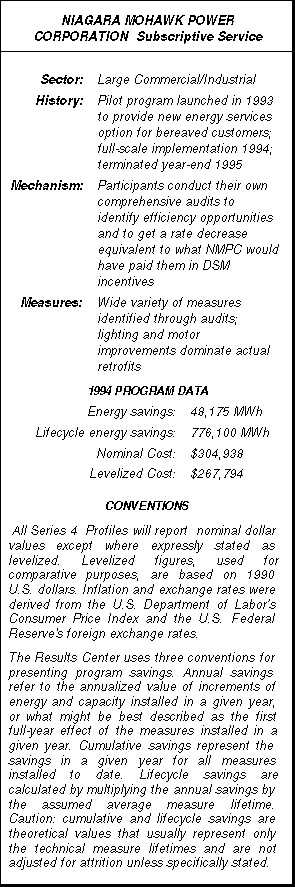 Niagara Mohawk Power Corporation’s (NMPC) Subscriptive Service represents an intriguing, albeit highly controversial, model for customer energy efficiency programs. Responding to large customers’ needs for choice and rate relief while maintaining an emphasis on achieving prescribed energy savings goals, NMPC designed a new energy services concept by unbundling its services. The Subscriptive Service provides an option for large customers that are committed to efficiency but elect to cover the costs of such upgrades on their own. Concurrently, NMPC continued to provide rebates to customers that determined that the Subscriptive Service was not economically feasible or who were pleased with prior DSM offerings.
The Subscriptive Service pilot program tested a new means of giving customers the incentive to invest in energy efficiency. Those that agreed to complete comprehensive energy audits which recommended energy conservation measures (ECMs) for their facilities were given a rate discount. The discount represented the costs they would have paid to be eligible for the utility’s traditional DSM incentives. Through this program mechanism the Subscriptive Service provided increased flexibility for customers to mine and pay for efficiency upgrades.
As with any test, measuring the effect of the program has been a major program emphasis and challenge. What was the direct program affect? Which recommended measures were installed? And most importantly, how effective was this program design compared to more traditional models? Unfortunately, there was no clear control group with which to measure savings, determining the quality of the audits was complex, as was ascertaining the effect of the program within a changing regulatory context. Nevertheless, by tieing NMPC’s shareholder incentives to the program’s energy savings goals, the Subscriptive Service earned requisite utility attention and resulted in nearly 50 GWh of energy savings.
While many efficiency advocates have been alarmed by the Subscriptive Service, claiming that it is simply a means for industrials to "opt-out" of paying their fair share of system efficiency costs, the model may have greater transferability and applicability than first meets the eye. The Subscriptive Service not only provides for customer choice but is an exciting model of how a utility can form a bond or contract with customers to be efficient. Rather than offering rebates and other direct incentives to garner utilities’ least-cost resource, the Subscriptive Service represents a new construct in which customers pledge to consider certain efficiency steps in the absence of incentives. The model, rather than the "death of DSM," may actually provide for a new, perhaps very resilient and logical means for the capture of energy efficiency.
[CLICK HERE TO DOWNLOAD THE ENTIRE 24 PAGE PROFILE IN PDF FILE FORMAT]
This profile was produced by