


EXECUTIVE SUMMARY
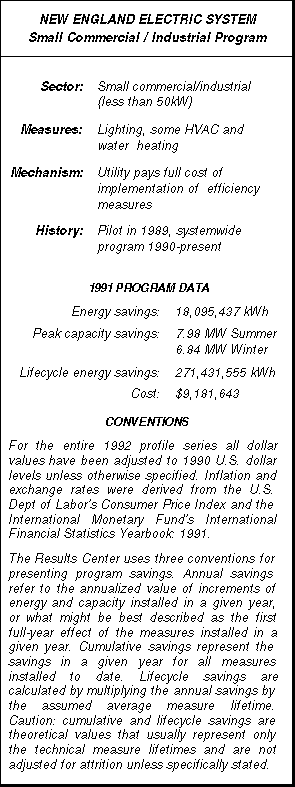 The New England Electric System’s "direct installation" Small Commercial and Industrial Program (Small C/I Program) addresses the unique needs of small businesses with power requirements of less than 50 kW, a customer class that is vital to the resilience of the local economy. Small C/I customers have been hard to attract with rebates for the purchase of energy-efficient equipment, but by paying 100% of the cost of auditing customers' facilities and installing energy-efficient equipment and backed by the credibility of the utility, this program has demonstrated the potential for very high penetration rates while remaining cost effective. Perhaps the most elegant aspect of the program is that it is administered by a skeleton staff in coordination with regional labor and product vendors. These trade allies market the program, do the retrofit analyses, provide the equipment, and do the installations. This keeps the utility’s overhead low (and thus administrative costs low) and stimulates business in the local economy. All product is purchased locally to stimulate local distribution of energy-efficient goods while bolstering the economy.
While the NEES Companies do a first rate job of analyzing DSM program data, their programs are relatively young and thus critical impact evaluations are not yet complete. Many of the assumptions built into the savings data therefore are based on early estimates from the program’s Rhode Island pilot. NEES uses adjustment factors, based on limited subsets from the pilot, for estimating savings for the system-wide program
In 1991 the Small C/I program resulted in average customer savings of 7,256 kWh, up significantly from its pilot average of 4,011 kWh. To date the program has resulted in total cumulative savings of 54 GWh when factoring in NEES’s engineering estimate of savings. The measures installed in 1991 had an average measure lifetime of 15 years. In terms of capacity the program has delivered a total of 14.27 MW of peak summer capacity.
This program has been a key example of the cost effectiveness of direct installation. Since the program’s inception NEES has spent nearly $20 million on this effort, resulting in an a 1991 cost of saved energy of 5.15 cents per kWh. While paying an average of nearly $5,000 per installation, and nearly $17,000 for schools, NEES has demonstrated the benefit to the utility and to its ratepayers of such a program. NEES has pioneered incentive mechanisms that has made its DSM activities profitable for consumers and shareholders alike. Perhaps most encouraging are a host of lessons learned through the program, further lowering administrative costs and resulting in the implementation of efficiency measures in over 95% of solicited customers.
[CLICK HERE TO DOWNLOAD THE ENTIRE 21 PAGE PROFILE IN PDF FILE FORMAT]
This profile was produced by