

EXECUTIVE SUMMARY
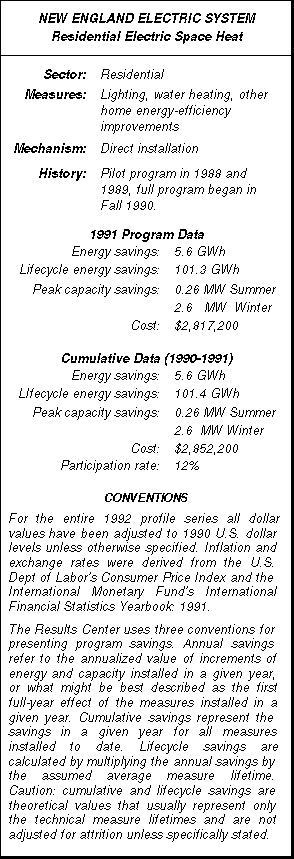 The New England Electric System’s (NEES) Residential Electric Space Heat program (RESH) is a direct installation program that provides energy efficiency improvement measures and information at no cost or low cost to residential customers with electric space heat. Of NEES’s 1.1 million residential accounts served by three retail companies, just 5% are moderate and high-use electric heat customers. The RESH program was designed to capture energy savings for these customers who live in one to four-family buildings.
The system-wide program’s design and implementation was built on experience gained from a demonstration project in Northhampton, Massachusetts in which 213 electric space heat customers with annual usage above 10,000 kWh were served with efficiency measures in 1988 and 1989. The full-scale implementation of RESH began in the fall of 1990, targeting high-use electric space heat customers.[R#6]
RESH is administered by NEES staff, who perform program planning, evaluation, and daily oversight, while contracted energy service companies deliver the program to customers. These companies promote the program, do followup telemarketing, install the measures, and are responsible for one-on-one customer relations. Approximately 96% of the program budget flows to the contractors for labor and supplies.
During 1991, 3,177 customers participated in RESH resulting in annual energy savings of 5,597 MWh, or 1,762 kWh per customer, about 5% of the average homes’ electricity use. By the end of 1992, NEES anticipates that it will have reached 13% of the target market. The program is planned to run through the year 2000; at that point NEES hopes to have served 67% of the Massachusetts market, 65% of the Rhode Island market, and 69% of the New Hampshire market.[R#7,9]
NEES has spent an average of $887 per customer in implementing the program in 1991. There is no spending limit per household, and NEES will install whatever cost-effective measures are appropriate, as determined by a Technical Assessment. At the time of the technical assesment, contractors provide energy-efficiency information (including information regarding appliances), compact flourescents are installed, blower door tests are performed, air sealing measures are performed, and water heating efficiency improvements are made. If cost effective, contractors return to install hardwired efficient lighting fixtures; attic, basement and wall insulation; and window and door improvements.
[CLICK HERE TO DOWNLOAD THE ENTIRE 19 PAGE PROFILE IN PDF FILE FORMAT]
This profile was produced by