
EXECUTIVE SUMMARY
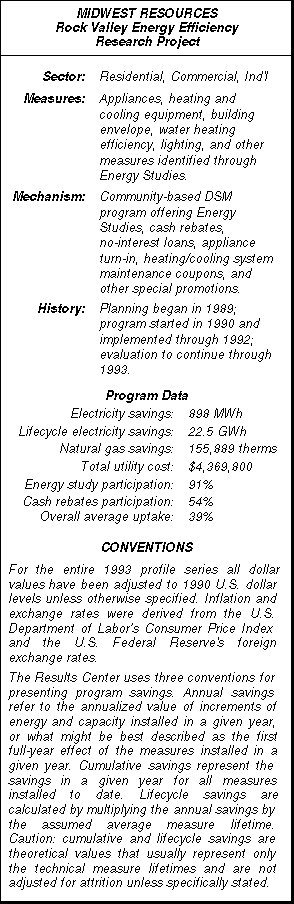 The Rock Valley Energy Efficiency Research Project (RVEERP) sponsored by Midwest Resources is a comprehensive DSM program designed to demonstrate the potential of a community-based approach to influence the energy consumption of an entire community. The program addresses technological, financial, social, regulatory, energy-efficiency, and research goals.
RVEERP is being implemented in Rock Valley, a town with a population of about 3,000 located in northwest Iowa. All of the town’s residents, businesses, and industries are eligible to take advantage of the program’s offerings regardless of whether their primary heating fuel is electricity or gas. Implementation of RVEERP was done in three basic steps. First, customers were invited to schedule an Energy Study and the study was performed and results explained to the customer. Second, customers could participate in any of four financial incentive programs: rebates, no-interest loans, appliance trade-in, or maintenance coupons. Third, Energy Study participants were offered the opportunity to have free blower door tests performed.
The centerpiece of RVEERP’s monitoring plan is the installation of Metricom two-way communicating meters at every electric and gas meter in the town of Rock Valley. The meters are capable of transmitting electricity and gas use data and can provide information for load research, distribution automation, direct load control, rate experiments, and customer feedback.
RVEERP’s annual savings have been estimated in several ways. First, staff determined the potential savings that could be realized in Rock Valley if 100% of the population installed 100% of the measures recommended in the Energy Studies. Because so much of the energy savings in Rock Valley are through natural gas, RVEERP converted the electricity and gas savings to Btus, finding total potential savings of 64,411 MMBtus, equivalent to 27% over the base year. Second, a survey of 612 residential participants revealed that 39% of the energy-efficiency measures that had been recommended in the Energy Study either had been implemented or the customers had concrete plans to implement them. Based on an analysis of 742 residential customers, 65 small commercial and industrial customers, and 60 large C/I customers, the estimated annual energy savings per participant is 341 kWh per residential customer, 2,215 kWh per small C/I customer, and 8,367 kWh per large C/I customer.
Almost $4.4 million has been spent on RVEERP since the project was initiated in 1990. Using a methodology that takes into account both electricity and gas savings, the cost of saved energy of RVEERP based on all expenditures through December 31, 1992, ranges from 4.59 ¢/kWh to 8.14 ¢/kWh, depending on the discount rate used.
[CLICK HERE TO DOWNLOAD THE ENTIRE 23 PAGE PROFILE IN PDF FILE FORMAT]
This profile was produced by