



EXECUTIVE SUMMARY
 The State of Iowa has proven to be an incubator for good ideas and the Iowa Energy Bank is yet another home-grown concept that deserves recognition and that will likely result in replication. The Energy Bank has been spurred on by several factors not the least of which has been the state’s 97% dependence on out-of-state energy supplies. Iowa is not only energy poor, but annual energy purchases have drained its economy to the tune of over $4 billion per year.
In 1985 the Iowa legislature mandated its Department of Natural Resources to design and implement major energy efficiency initiatives for traditionally difficult market segments: public and non-profit facilities. The resulting Iowa Building Energy Management Program targets state and local government facilities, public school districts and area education agencies, private universities, hospitals, and other non-profit groups. The goal of the program is to install all cost-effective efficiency improvements in these facilities with an aggregate payback period of six years or less by 1998.
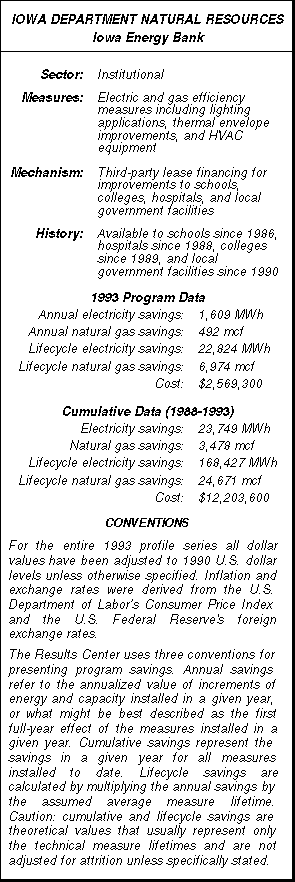
The Iowa Energy Bank is a subset of the Building Energy Management Program and was established to facilitate and finance energy improvements in Iowa’s 418 school districts, 128 hospitals, 34 private colleges and 15 community colleges, and 967 local governments. (State facilities are addressed under a parallel program called the State of Iowa Facilities Improvement Corporation.) The Department of Natural Resources determined that a combination of audits and engineering analysis followed by lease financing was the most attractive mechanism for the retrofits, allowing public institutions to avoid issuing bonds or calling public referendums to secure the necessary capital. This form of financing also allows the costs of the payments to be less than or equal to the monthly savings from the improvements, providing a win-win situation in this debt-averse state. Participants can also secure financing from alternative sources and the program has recently been enhanced to take advantage of capital loan notes.
Cumulative enrollment in the Energy Bank to date has been very impressive. Already the program has reached 390 participants or 22% of the eligible customers with 265 school districts providing the largest fraction of the savings. Twenty-one hospitals have also undergone retrofits. Of the total participants, 212 have financed improvements through the Energy Bank engaging $8,927,400 worth of retrofit improvements which have resulted in cumulative savings of nearly 23 GWh and over 105 GWh equivalent of natural gas.
[CLICK HERE TO DOWNLOAD THE ENTIRE 20 PAGE PROFILE IN PDF FILE FORMAT]
This profile was produced by