







EXECUTIVE SUMMARY
 For many years Americans have been familiar with the U.S. EPA’s miles per gallon ratings which clearly identify the fuel economy of cars. More recently Americans have become attuned to the bright yellow energy guides found on refrigerators, freezers, and air conditioners in household appliance showrooms. Illogically, however, homes are generally not rated for their fuel economy. The lifecycle energy costs of a home, like a car or appliance, are important values which to date have been invisible to consumers, and as a result home buyers assess their decisions based only on homes’ first costs.
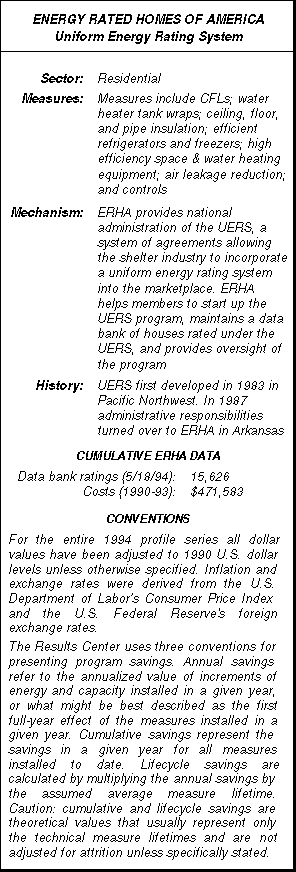
Energy Rated Homes of AmericaTM believes that by rating homes consumers will be better armed to make critical home buying decisions. This in turn, will push the entire "shelter industry" (from builders to appraisers to real estate agents to lenders) to focus more on homes’ energy efficiency, an awareness that will inevitably reduce household energy consumption and make housing more affordable.
Based on ratings from ERHA’s Uniform Energy Rating SystemTM, lenders can be confident that homes classified as "efficient" will indeed have lower utility bills and that their home owners will have more money to spend on their monthly mortgage payments. A host of innovative lending practices are being piloted and implemented that take advantage of the transferability of these savings into mortgage payments. Thus lenders are easing and “stretching” home owners’ debt-to-income ratios for energy-efficient homes.
Rating sheets for homes developed from the Uniform Energy Rating System provide an "as-is" rating for the home based on a 100-point scale. An "improvement-options" rating also provides an indication of how homes would rate as well as potential savings if they followed a set of fully detailed retrofit measures, in an improvement sheet. Thus the process of rating a home not only provides a score, but provides the home owner with cost effective and suggested improvements. Furthermore, the funds necessary to carry out these improvements can be added to mortgages, allowing inefficient homes to be upgraded and the cost of improvements financed over the life of the loan.
To date, Energy Rated Homes of America’s Uniform Energy Rating System has been implemented in 12 states using a variety of implementation strategies. Sometimes the program is run by a utility or the state itself, but typically the program is run by a non-profit group and funded through a combination of home owners, builders, and utilities keen on coupling ratings with their new and existing home construction programs.
[CLICK HERE TO DOWNLOAD THE ENTIRE 23 PAGE PROFILE IN PDF FILE FORMAT]
This profile was produced by