EXECUTIVE SUMMARY
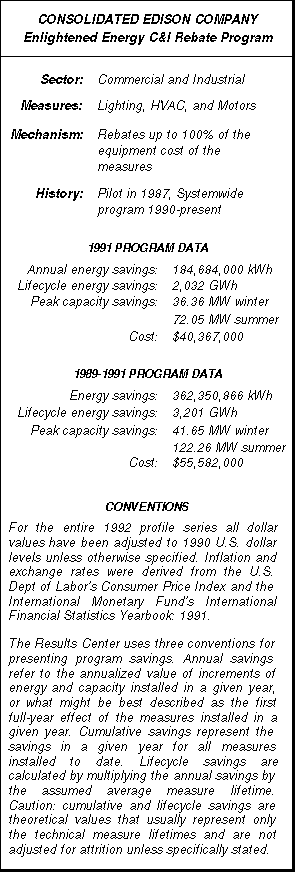 Consolidated Edison's Enlightened Energy C&I Rebate Program for commercial and industrial customers provides rebates to eligible customers who install efficient lights, HVAC equipment, and motors. Con Edison drew much attention to the program in its early stages, which was previously referred to as the Applepower Program, when its rebate levels for summer peak coincident demand were $500/kW -- far above average national rebate levels. Con Edison's interest was straightforward: to eliminate the need for expensive upgrades of midtown (New York City) substations. Now the program has a broader agenda and incentive mechanisms in New York have made it possible for Con Edison to embrace DSM as a profitable corporate strategy.
One of the most interesting aspects of the Enlightened Energy C&I Rebate Program is its use of fuel substitution as a tool for capturing energy efficiency. Because Con Edison provides electricity, gas, and steam service, the utility has found cost effective means of encouraging customer fuel switching without the threat of lost revenues. (Con Edison does, however, provide rebates for gas air conditioning installations to its electric customers who reside in the Brooklyn Union Gas service territory.) Significant electricity savings are realized by the utility as a result of the steam and gas air conditioning rebate components. The steam and gas air conditioning programs take advantage of the fact that steam and gas demands peak during the winter, and excess capacity is available during the summer.
The measures included in the Enlightened Energy C&I Rebate Program have been implemented on a smaller scale for several years. The program expanded significantly in 1991 due to a shift in the focus of the utility's DSM efforts from peak demand reduction to a total energy savings approach. This shift in emphasis brought increased spending for the rebate program, and resulted in significant overall program growth. Lighting design and service companies have promoted the availability of rebates for efficient lighting projects, and the lighting rebate measures have experienced a large expansion due in part to this activity.
In 1991 Con Edison spent over $40 million to achieve summer peak capacity savings of 72 MW and energy savings of 184 GWh. One of the celebrated examples of the program's effect is the campuswide lighting retrofit that is underway at Columbia University. A third party energy service company is financing the 42-building retrofit, and is using Con Edison's $1 million rebate as an impetus to realize fast and highly cost effective savings for the cash-strapped university.
[CLICK HERE TO DOWNLOAD THE ENTIRE 22 PAGE PROFILE IN PDF FILE FORMAT]
This profile was produced by