


EXECUTIVE SUMMARY
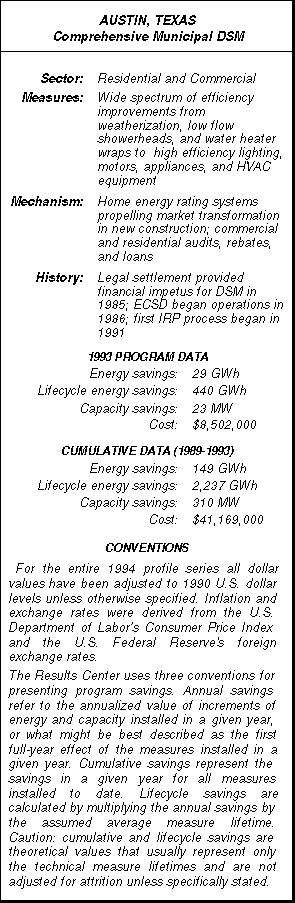 The City of Austin, Texas has proven that adversity related to power supplies can be fully exploited for advantage. From its investment in the South Texas Nuclear Project and award of $120 million in a lawsuit over the plant, Austin has developed one of the most impressive demand-side management programs in the country. The programs are comprehensive and thorough, ranging from commercial loans to residential direct assistance, from tree planting to thermal energy storage systems. Perhaps most telling is Austin’s Green Builder program, awarded at the Earth Summit in Rio de Janeiro, which factors other resource efficiency aspects into its new construction program. Green Builder may represent a wave of the future, incorporating DSM into a broader context including water management, recycling, and taking a careful look at the embedded energy and environmental costs of building materials.
The structure of demand-side management in Austin is quite unique. The City has an Electric Department, but elected to establish its energy efficiency initiatives under the auspices of the Environmental and Conservation Services Department (ECSD), a separate City agency. The ECSD is autonomous from the Electric Department, allowing it the freedom to implement a wide array of beneficial programs, even working with the local natural gas utility, Southern Union Gas, to implement a range of gas technologies programs. The ECSD and the Electric Department are formally linked in two ways: Most of ECSD’s programs are funded directly by the Electric Department. The two city agencies are working together to develop their first integrated resource plan for future resource requirements.
Another key feature of Austin’s energy efficiency work is the keen focus on social aspects of efficiency and the quality of life. An evaluation of its low income Direct Weatherization program, for instance, found that besides saving money the program’s participants also managed to increase their comfort level closer to the City-wide average. As was expected, these lower-income utility customers kept their homes colder in the winter and hotter in the summer and the program allowed these customers to improve their comfort and save money simultaneously. ECSD has also spent time and resources quantifying the economic impacts of its energy efficiency programs, examining the economic benefits and multipliers of saving money in the community and investing in energy efficiency, boosting employment and product sales in the local economy. The City also developed an externality cost model to quantify the avoided emissions created by its energy efficiency programs, a focus that resulted in Austin being the first municipality in the country to receive sulfur dioxide emissions allowances under the federal Clean Air Act Amendments of 1990.
[CLICK HERE TO DOWNLOAD THE ENTIRE 24 PAGE PROFILE IN PDF FILE FORMAT]
This profile was produced by