

EXECUTIVE SUMMARY
 The California Energy Commission staff estimates that California local governments spend over a billion dollars annually to purchase electricity, natural gas, and transportation fuels. While energy costs for cities and counties are a small portion of their overall operating budgets (typically 1-5%), it is one of the few costs that can be reduced because it is not fixed. Through its programs the Commission’s staff have projected that on selected local government facilities up to 25% can be saved on energy costs.
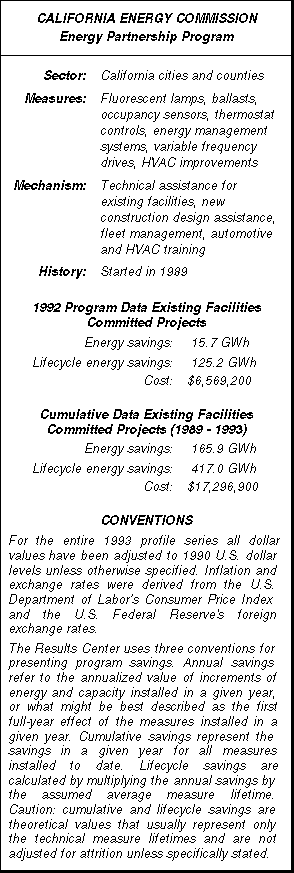
Thanks in large part to California State Senate Bill 880 (1986), the California Energy Commission has been given and has carried out a broad mandate to improve energy efficiency in the state’s cities, counties, and school facilities. The Energy Partnership Program (EPP), a subset of this activity, is the focus of this profile. EPP addresses the energy efficiency of city and county facilities and provides technical assistance for existing facilities, new construction design assistance, fleet management assistance and training, automotive and HVAC training, loans, and awards for participants.
While this profile addresses all components of the EPP program, technical assistance for existing facilities is the largest component in terms of participants, expenditures, and staff time. The Commission contracts with private consultants to provide technical assistance for all types of local government facilities including city halls, administration buildings, libraries, fire departments, police departments, and wastewater treatment plants. One interesting aspect of the program is that the Commission targeted jails and hospitals which have 24-hour, energy-intensive operations.
An important part of the program is to facilitate project financing for energy efficiency upgrades through its own revolving loan fund, federal funds, utility assistance, energy service companies, or other outside funding sources. In order to access its revolving fund which has a highly competitive interest rate, projects must have a simple payback of 6.5 years or less. Large funding requests (over $250,000) are often referred to private sector sources such as municipal leasing companies and pooled bond mechanisms. Pooled bond programs available include the FARECAL program administered by the California Municipal Utility Association, the CASTLE program administered by the California State Association of Counties, and the ABAG program administered by the Association of Bay Area Governments.
[CLICK HERE TO DOWNLOAD THE ENTIRE 22 PAGE PROFILE IN PDF FILE FORMAT]
This profile was produced by