




EXECUTIVE SUMMARY
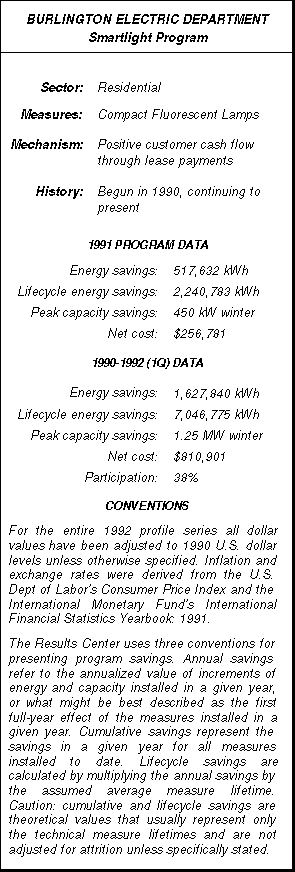 In 1990 the voters of Burlington, Vermont authorized the Burlington Electric Department (BED) to issue an $11 million bond to invest in energy efficiency. Many voters took the opportunity to make it clear that they favored energy efficiency over the prospect of buying additional increments of Hydro-Quebec's James Bay power, another element in the resource plan.
As part of its overall efficiency initiative BED staff opted to employ a lightbulb leasing mechanism that had been pioneered at Taunton, Mass. Municipal Lighting Plant. There, Joe Desmond had a rather elegant idea. By leasing customers compact fluorescent lamps wouldn't it be possible for a utility to offer positive cash flow for customers (where bill savings were greater than lease payments), while at the same time providing savings for the utility at low cost? The "Smartlight" program has been refined in Burlington and is the largest program of its kind in the country.
In the first fifteen months of the program BED had distributed almost 25,000 bulbs to over five thousand residential customers. After 20 months BED had installed 26,602 bulbs, averaging 3.4 lamps per customer, for estimated savings of 1,300 MWh/year. Burlington Electric, with a total of 33,647 energy-efficient lamps distributed in the community, is now in the process of extending leasing to commercial lighting.
BED's Smartlight Program also was able to effectively use college students on summer vacation to educate sustomers about energy efficiency and the leasing mechanism, and to install the lamps in appropriate applications. Selct students were retained during the school year to perform installations.
One of the interesting lessons learned from Burlington's Smartlight program is that the lease payments themselves have been a relatively insignificant aspect of the program. BED program managers feel that the point is the education of their customers, and their commitment to have the lamps only in cost effective sockets. The profile concludes with a discussion of the relative merits of the leasing concept versus direct installation programs for residential lighting.
BED provides a fascinating case study of an innovative, positive cash flow, DSM implementation strategy. Costs of the program are somewhat elusive, as lamps placed today have a net present value in terms of lease payments. This, however, is offset in part by attrition rates of the lamps. Finally, the savings data is complicated by the fact that a certain percentage of installed lamps maintain active leases, while another subset are likely in service but their leases have been broken.
[CLICK HERE TO DOWNLOAD THE ENTIRE 23 PAGE PROFILE IN PDF FILE FORMAT]
This profile was produced by