




EXECUTIVE SUMMARY
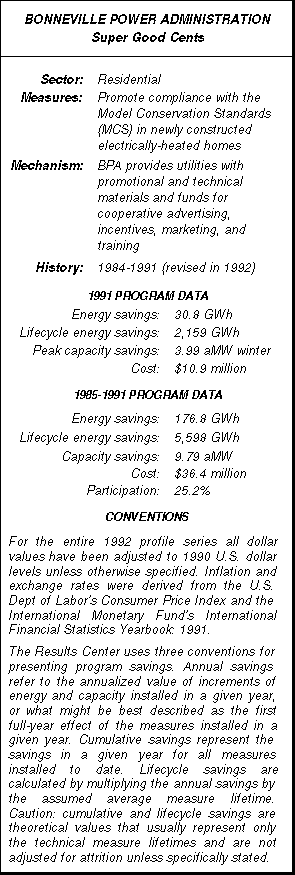 Bonneville Power Administration (BPA) has spent over a billion dollars on DSM since 1982. BPA's Super Good Cents (SGC) program focuses on increasing the efficiency of new, electrically-heated residential construction by offering incentives for efficiency that met the Northwest Power Planning Council's Model Conservation Standards (MCS).
The Super Good Cents program, which commenced in 1984, was part of a two-pronged implementation effort. The SGC program was a marketing and education program promoting energy-efficient building practices. The other prong of the effort was a building code adoption program called Early Adopter. Both programs were designed to take advantage of the opportunity cost of building new homes to higher energy efficiency standards rather than trying to retrofit them at some later date. Inversely, both programs were designed to avoid the lost opportunity of not building energy-efficient homes in the first place.
The objectives of making both the public and the home builders aware of the SGC program and the advantages of a well-insulated home were largely achieved. The participation rate for certified SGC homes built within the BPA service territory (25%), however, fell short of the program's stated goals.
In 1991 SGC provided BPA and its retail utilities with 30.8 GWh of energy savings and 3.99 average megawatts of capacity, at a cost of $10.9 million. These savings were achieved by providing incentives for increased ceiling, wall, floor, and slab perimeter insulation; duct insulation for heating and cooling systems; double or triple pane windows; and thermally improved doors. Through 1991 BPA paid $1,000 for each site-built home constructed to SGC standards, and $2,000 for new manufactured housing.
The overall results of SGC have to be considered excellent. In 1991 the states of Washington and Oregon, representing 90% of the new home starts within the BPA service territory, adopted building codes whose specifications met the SGC standards. This required BPA to reevaluate the program and to set higher building standards for the 1992 SGC program.
[CLICK HERE TO DOWNLOAD THE ENTIRE 19 PAGE PROFILE IN PDF FILE FORMAT]
This profile was produced by