

EXECUTIVE SUMMARY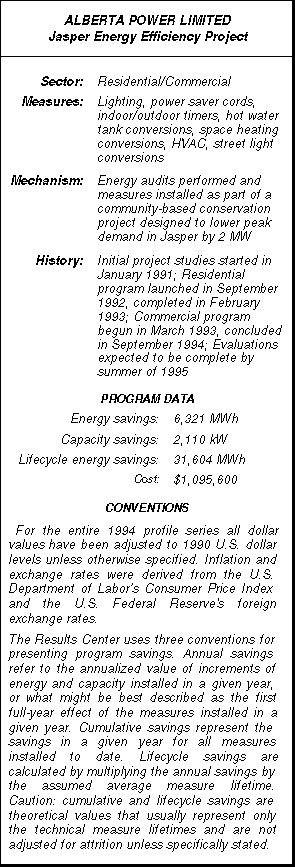 The Jasper Energy Efficiency Project (JEEP) was recently completed in Jasper, Alberta and was a comprehensive, community-based effort that effectively used energy efficiency to reduce the demand for power thereby avoiding the need for more generating capacity. The project was also explicitly intended to research the potential for this kind of approach for other communities in Alberta Power Limited’s (APL) service area and was the first project of its kind in western Canada. In both residential and commercial sectors JEEP was carried out through aggressive marketing and educational campaigns (including door-to-door energy audits, marketing, and sales), and incentives.
Community support for JEEP was deemed essential to its success and endurance. To this end Alberta Power established the Public Information Committee which was involved in all phases of the project from planning to marketing and implementation. Representatives from the general public, various interest groups, and Alberta Power were a part of this committee that met monthly and operated on a consensus basis. Alberta Power also hired and trained residents of Jasper, who really knew the community, to go door-to-door explaining, selling and installing energy-efficient products that were obtained by the utility through a local supplier ensuring that they would be available once the project was completed. APL forged close ties with the local media to further community awareness and excitement. Wilfred Golbeck, the Alberta Power project coordinator actually moved to Jasper during the project making the power company readily accessible and responsive.
JEEP has been highly successful on a number of levels. Over 70% of residential and 53% of commercial customers participated in the program which exceeded its goal of a 2 MW (almost 20%) demand reduction with an annual energy savings of over six million kWh. On average, residential customers have saved 0.73 kW of demand and commercial customers nearly 15 kW. APL invested almost $1,095,600 in the project, the community $630,000, and the federal government $70,000 for a total of $1,795,600. In addition and another indicator of the project’s success, fully 38% of the residential program participants indicated in a follow-up telephone survey that they had undertaken additional energy-efficiency measures outside of the program. Corroborating this, the local hardware store reports having sold 1,000 additional compact fluorescent lamps since the project’s completion. These indicators attest to the deep level of education achieved through JEEP and the program’s success in terms of initiating a market transformation in Jasper, perhaps the project’s greatest success.
[CLICK HERE TO DOWNLOAD THE ENTIRE 24 PAGE PROFILE IN PDF FILE FORMAT]
This profile was produced by